Marble looks solid, smooth, and almost glass-like under soft lighting. Yet its surface contains microscopic pores, mineral boundaries, and tiny pathways formed during geological change. Why is marble porous and what does it mean? The answer begins with marble’s natural structure, not with poor manufacturing or visible damage. Heat, pressure, crystallization, and mineral composition shape how much moisture the stone can absorb.
In practical stone inspections, a clean marble countertop may still darken briefly after contact with water, oil, or coffee. A pale ring near a sink can reveal absorption rather than a simple surface stain. Experienced fabricators and conservators assess these changes carefully, using controlled water-drop tests, lighting, and the stone’s finish. However, one test cannot explain every mark. Porosity varies between slabs, even when they come from the same quarry.
Understanding this behavior helps homeowners choose suitable cleaners, sealers, and maintenance routines. Natural-stone authorities generally recommend pH-neutral products and avoiding harsh acids, abrasive powders, and prolonged spills. Sealing can reduce absorption, but it does not make marble permanently waterproof. That distinction matters.
Small details count.
This guide examines marble’s pore structure, absorption, staining risks, and realistic care requirements. It also questions common assumptions, because “sealed” does not always mean “protected forever.” Reliable decisions should consider the marble’s color, finish, location, exposure, and daily use. A bathroom vanity faces different risks from a rarely used hallway table. Proper understanding protects both the stone and the investment behind it.
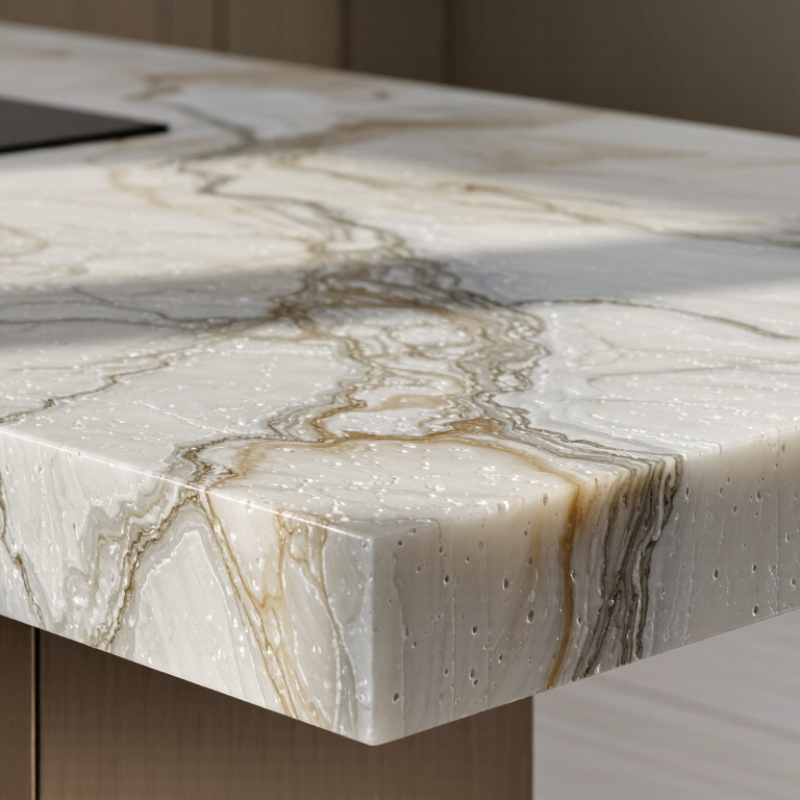
Marble begins as limestone, usually rich in calcite, buried under heat and pressure. During metamorphism, its crystals recrystallize and interlock. Fossils may disappear. Veins can form when mineral-bearing fluids move through small fractures. The result is not one uniform stone. Its mineral structure changes from block to block. Dolomite, quartz, mica, and iron minerals may also appear. These differences influence color, hardness, staining, and water movement.
Porosity describes the small spaces between or within mineral grains. Recrystallized marble often has low open porosity, but it is never perfectly sealed. Technical stone-testing guidance uses water absorption and bulk density to assess this behavior. ASTM C97/C97M is a common industry method. Data summarized in the Natural Stone Institute’s Dimension Stone Design Manual show that absorption varies significantly among marble types, often from below 0.5% to several percent by mass. That range matters. A polished white marble may resist rapid absorption, while a veined or fractured sample may darken quickly.
USGS Mineral Commodity Summaries classify marble within dimension stone, but broad production statistics cannot predict one slab’s performance. That is the practical limitation. I have seen two pieces from the same quarry react differently to a damp cloth. Mineral boundaries, microcracks, and surface finish can change the result. For reliable selection, request project-specific absorption data and review testing against ASTM C97/C97M. Porosity is not a defect by itself. It is a record of how the stone formed.
| Data Dimension | Typical or Scientific Information | Why It Matters |
|---|---|---|
| Rock classification | Marble is a metamorphic rock formed when limestone or dolostone is altered by heat, pressure, and chemically active fluids. | Its original sedimentary structure is recrystallized, producing a dense stone with variable grain size and pore structure. |
| Main minerals | Calcite is the dominant mineral in most marbles. Dolomite may dominate in dolomitic marble, while accessory minerals can include quartz, mica, graphite, pyrite, or iron-bearing minerals. | Mineral composition affects color, veining, chemical resistance, hardness, and finishing behavior. |
| Primary mineral hardness | Calcite has a Mohs hardness of about 3; dolomite is approximately 3.5–4. | Marble can scratch more easily than many silicate stones, especially when exposed to sand or abrasive particles. |
| Crystal structure | Metamorphism commonly produces interlocking calcite or dolomite crystals. Crystal size may range from fine to coarse depending on geological conditions. | Interlocking crystals provide strength, but the spaces and boundaries between grains can contribute to connected microscopic pathways. |
| Why marble is porous | Porosity can result from intergranular spaces, microscopic fractures, cleavage-related gaps, fossil remnants, and irregular recrystallization. | Liquids may enter the stone even when the surface appears smooth and compact. |
| Open versus closed pores | Open pores connect with the surface and can absorb water or staining liquids. Closed pores are isolated and generally do not contribute to surface absorption. | Open porosity has a greater practical effect on staining, moisture movement, and sealer performance than total porosity alone. |
| Typical water absorption | Many commercial marbles have water absorption values below approximately 1%, but tested values can vary from well below 0.5% to above 2% depending on the specific stone. | A material data sheet or laboratory test is more reliable than judging porosity by appearance. |
| Visible pores and pits | Some slabs show small pits, vugs, veins, or filled natural cavities caused by mineral inclusions, fractures, or dissolution before metamorphism. | Surface appearance may reveal local variations, but visible features do not measure the stone’s total internal porosity. |
| Effect of acidic substances | Calcite reacts readily with acids. Citrus juice, vinegar, acidic cleaners, and some food or drink residues can etch polished marble. | Etching is a chemical change to the mineral surface, not simply a stain, and sealing does not make calcite acid-proof. |
| Staining potential | Oil, coffee, wine, colored liquids, and rust-producing materials can penetrate accessible pores or microfractures, especially if spills remain on the surface. | Prompt cleanup reduces contact time and lowers the chance of deep discoloration. |
| Role of a penetrating sealer | A penetrating sealer can reduce the rate at which certain liquids enter open pores, but it does not create an impermeable film or prevent acid etching. | Sealing improves stain resistance but does not eliminate routine cleaning and spill management. |
| Recommended cleaning approach | Use a pH-neutral cleaner intended for natural stone, clean spills promptly, and avoid abrasive powders and acidic household products. | Gentle cleaning helps preserve the polish and prevents chemical damage to calcite-rich surfaces. |
| Best way to compare two marbles | Compare water absorption, bulk density, flexural strength, abrasion resistance, mineral composition, finish, and intended use. | Two stones that look similar can perform differently because their mineral structure and connected pore networks are not identical. |
| Suitable application considerations | Marble is commonly used for walls, floors, stairs, vanities, and decorative surfaces, but the specific variety should be evaluated for moisture, traffic, abrasion, and chemical exposure. | Application suitability depends on the tested properties of the selected stone rather than the general name “marble.” |
Marble forms from limestone under heat and pressure. Tiny gaps remain between calcite crystals, fossil cavities, and mineral veins. Some pores connect through microcracks. Acidic water can slowly enlarge them.
No. Porosity varies between stones, even within one quarry. A dense white slab may resist moisture, while a similar-looking slab absorbs it near cut edges. Appearance alone is unreliable.
Place several water drops on a hidden area. Wait about ten minutes. If the stone darkens, it absorbs moisture. Wipe it dry and compare nearby areas.A drop test is only a clue. Cleaning chemicals, polish, and surface conditions can distort the result.
Water may enter around sinks, grout lines, scratched areas, and unsealed edges. Oil can leave a dark shadow near a cooking area. Coffee may stain around a cutout. Damage often develops quietly.
No. Sealing slows absorption and staining, but it does not remove pores. Apply sealer only to clean, dry marble. Test it on a spare piece first. Damp stone can cause uneven results.
Blot coffee, wine, oil, juice, and colored drinks immediately. Do not spread the spill with a wide wiping motion. An overnight stain may become much harder to remove. I sometimes underestimate that delay.
Use warm water and a pH-neutral cleaner. Dry the surface afterward to reduce dull water marks. Avoid vinegar, lemon juice, abrasive powders, and rough scrub pads. They can etch calcite instead of cleaning it.
It may, but moisture can freeze inside connected pores. Repeated freezing and thawing can widen tiny channels and weaken the stone. Higher absorption requires more careful selection. A glossy finish does not prove outdoor durability.
Marble is a natural stone formed when limestone changes under heat and pressure, causing its minerals to recrystallize into an interlocking structure. However, this structure is not completely solid. Tiny gaps can develop between mineral crystals, while natural fractures, veins, and areas of uneven crystallization may create additional pathways for air and moisture. Understanding why is marble porous and what does it mean helps explain why different marble types absorb liquids at different rates.
Porosity can influence marble’s strength, color, texture, and resistance to staining. Water may carry dirt or dissolved minerals into the stone, while acidic or harsh chemicals can react with its mineral content and damage the surface. Porous marble should be identified through visual inspection and simple absorption testing, then protected with an appropriate sealer. Regular dust removal, prompt cleaning of spills, gentle pH-neutral products, and periodic resealing can help preserve its appearance and reduce long-term deterioration.

 Gem Marble