What Is the Difference Between Marble and Dolomite?

Time:2026-10-16 Author:Madeline
0%

What is the difference between marble and dolomite? This question matters when selecting countertops, wall panels, flooring, or architectural stone. The answer begins with geology. Marble forms when limestone undergoes heat and pressure, changing its crystal structure. Dolomite, however, can refer to a mineral or to dolostone, a rock rich in the mineral dolomite. That distinction is often missed.

Geologist and mineral educator Hobart M. King describes dolomite as “a common rock-forming mineral” with a calcium-magnesium carbonate composition. This chemistry helps explain its behavior. Marble usually reacts more visibly with acids, while dolomite often resists mild acids more effectively. Both materials can scratch, stain, or etch, depending on their mineral content, finish, and maintenance. Neither stone is automatically maintenance-free.

Look closely at the surface.

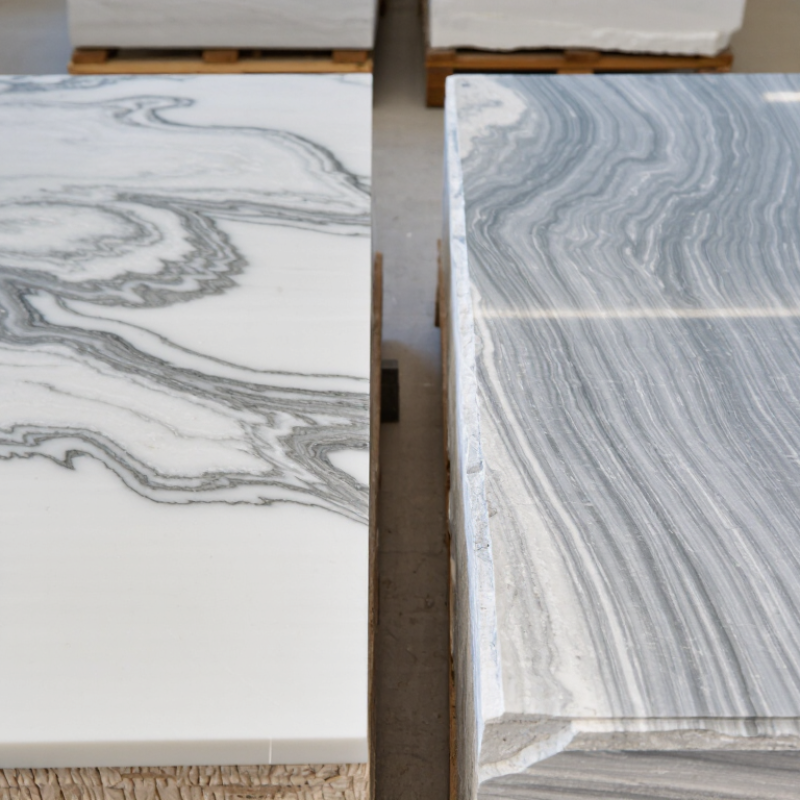
A polished slab can mislead the eye. Marble may show flowing veins, cloudy backgrounds, or dramatic bands. Dolomite often presents cooler white, gray, or blue-gray tones, but its appearance varies greatly. Color alone cannot confirm the stone’s identity. A fabricator or qualified stone professional should review the slab, technical data, and a small sample before installation. Acid testing should be controlled and professionally handled, because it can damage the finish.

There is room for uncertainty. Trade labels are sometimes inconsistent. A stone sold as “dolomite marble” may not fit strict geological terminology. That is why this guide compares composition, durability, appearance, testing, and practical care instead of relying on names alone.
What Is the Difference Between Marble and Dolomite?

What Are Marble and Dolomite?

Marble and dolomite are natural carbonate stones, but they form differently. Marble begins as limestone and changes under heat and pressure. Its calcite crystals recrystallize, often creating flowing veins and a soft, luminous surface. Dolomite may describe a mineral or dolostone, a rock rich in the mineral dolomite. Its formula is CaMg(CO3)2, while calcite is CaCO3. That magnesium difference affects polishing, acid reaction, and long-term performance.

The Mineralogical Society of America records dolomite at about 3.5–4 on the Mohs scale. Calcite measures about 3. This small-looking gap matters around sinks, floors, and busy counters. The U.S. Geological Survey’s 2024 Mineral Commodity Summaries identifies limestone and dolomite as major raw materials for crushed stone, cement, and lime. USGS data also place U.S. crushed-stone output at roughly 1.9 billion metric tons in 2023, showing the enormous industrial role of carbonate rock. Decorative slabs represent only a small part of that market.

In practical inspections, a marble sample usually fizzes quickly with dilute acid, especially on a fresh edge. Dolomite often reacts weakly or slowly. Still, this test is not perfect. Polished faces, sealers, and mixed mineral content can mislead an inexperienced observer. Color is unreliable too. White dolomite may resemble marble, while veined marble can appear almost identical to dolostone under showroom lighting. A laboratory thin-section or mineral analysis provides stronger evidence before specification.

How Marble and Dolomite Form

Marble and dolomite begin with carbonate-rich rocks, but their geological paths differ. Marble forms when limestone or dolostone is buried and altered by heat and pressure. Recrystallization grows interlocking calcite or dolomite crystals. Fossils, shells, and bedding may disappear.

Dolomite often forms earlier. Magnesium-rich groundwater can replace some calcium in limestone during burial or later fluid movement. The mineral dolomite contains calcium, magnesium, carbon, and oxygen. Dolomite rock may also preserve thin layers, pores, and sedimentary textures. It is not simply “unfinished marble.” Formation depends on fluid chemistry, depth, temperature, and time.

Field evidence can be subtle. A marble sample may show sugary crystals and weak layering, while dolostone may break along original beds. Yet the boundary is not tidy. Some marbles contain abundant dolomite, and some dolostones later experience metamorphism. Laboratory testing is safer than appearance alone.

The U.S. Geological Survey’s Mineral Commodity Summaries 2024 estimated U.S. crushed-stone output at about 1.5 billion metric tons in 2023. Limestone and dolomite accounted for roughly 70% of that volume. The British Geological Survey also identifies carbonate rocks as major construction materials, linking their geological history to aggregate performance. These reports measure production, not formation. That distinction matters when selecting stone for a project. Classification can still be imperfect.

How Their Mineral Compositions Differ

Marble and dolomite can look similar, but their mineral compositions differ sharply. Marble forms when limestone or dolostone recrystallizes under heat and pressure. Its main mineral is usually calcite, CaCO3, although some marble contains significant dolomite. Magnesium is the dividing detail.

The numbers make this clearer. Pure calcite contains about 40.0% calcium by oxide equivalent, while theoretical dolomite contains approximately 21.7% magnesium and 30.4% calcium. These figures come from mineral composition data compiled by the U.S. Geological Survey and the Handbook of Mineralogy.

Commercial stone rarely reaches theoretical purity. Trace quartz, mica, iron minerals, and clay can alter its color and performance.

Look closely at a cut slab. Calcite-rich marble often reacts more quickly with dilute hydrochloric acid. Dolomite reacts weakly unless scratched or powdered. This field test is useful, but it is not conclusive. Laboratory X-ray diffraction and chemical analysis provide stronger evidence. The USGS Mineral Commodity Summaries 2025 treats dimension stone mainly as a market category, not a purity grade. That distinction matters when comparing suppliers or specifications. A pale surface can still hide magnesium-rich zones. Hardness and staining behavior may also vary within one block. Classification is sometimes less tidy than photographs suggest.

How to Compare Their Appearance and Physical Properties

Marble and dolomite can look remarkably similar under showroom lighting. Both may show white, gray, cream, or soft green backgrounds. Marble usually displays flowing veins, while dolomite often has tighter, angular veining. Some dolomite slabs also show translucent crystals near the edge. I have seen samples change dramatically after wetting. A dry surface can hide those details. Color alone is unreliable.

Their physical properties create a clearer comparison. Geological reference data commonly place marble’s Mohs hardness around 3–5. Dolomite usually measures about 3.5–4. Their difference is modest. Scratch resistance still varies with mineral composition and weathering. Published stone data also commonly report densities near 2.6–2.8 g/cm³ for marble and about 2.8–2.9 g/cm³ for dolomite. These are useful ranges, not guarantees. The Natural Stone Institute recommends project-specific testing, while ASTM C97/C97M measures absorption and bulk specific gravity.

Acid sensitivity deserves careful attention. Calcite-rich marble can react quickly to lemon juice or acidic cleaners. Dolomite contains magnesium carbonate and may react more slowly, but it is not acid-proof. That distinction matters around sinks and cooking areas. ASTM C1353 testing can help evaluate abrasion resistance for flooring. However, a laboratory result cannot predict every slab’s behavior. Fabrication quality, sealing, finish, and daily maintenance also influence performance. A honed sample may reveal etching more honestly than a glossy one. I would request the actual test report, not a sales description. The report may expose an inconvenient difference between two slabs that look nearly identical.

What Is the Difference Between Marble and Dolomite? - How to Compare Their Appearance and Physical Properties

Comparison Dimension Marble Dolomite Key Difference
Geological classification A metamorphic rock formed when limestone or other carbonate rock recrystallizes under heat and pressure. Usually refers to dolostone, a sedimentary carbonate rock composed mainly of the mineral dolomite. “Dolomitic marble” is a metamorphosed dolostone. Origin and mineral content
Primary mineral composition Mainly calcite (calcium carbonate, CaCO3), although some varieties contain dolomite, quartz, mica, or other minerals. Mainly dolomite mineral, calcium magnesium carbonate, CaMg(CO3)2; some deposits also contain calcite and impurities. Calcite versus dolomite
Typical colors White, gray, cream, beige, pink, green, black, and many other colors depending on mineral impurities. Commonly white, gray, cream, tan, or pale brown; iron and other impurities may produce yellow, pink, or reddish tones. Both have broad color ranges
Veining and patterns Often displays prominent veins, swirls, or brecciation caused by mineral impurities and geological deformation. May show subtle veins, cloudy patterns, granular textures, or bedding; the pattern depends strongly on the deposit and degree of alteration. Marble often has more dramatic veining
Texture and crystal structure Interlocking crystalline texture created by recrystallization; grain size may range from fine to coarse. Typically granular or crystalline, with dolomite crystals that may be fine, medium, or coarse; sedimentary layering can sometimes remain visible. Marble is metamorphic; dolostone is generally sedimentary
Mohs hardness About 3 for calcite-rich marble; dolomitic marble may be slightly harder. About 3.5–4 for the dolomite mineral. Dolomite is generally harder
Typical density Approximately 2.6–2.8 g/cm3, depending on mineral composition and porosity. Approximately 2.8–2.9 g/cm3 for relatively pure dolomite-rich material. Dolomite is often slightly denser
Reaction to dilute hydrochloric acid Calcite-rich marble generally fizzes readily and visibly in cold dilute hydrochloric acid. Dolomite reacts weakly or slowly when powdered; a strong reaction may indicate significant calcite content. Acid testing can help identify the difference
Porosity and water absorption Usually low to moderate, but values vary considerably with grain size, cracks, and geological history. Usually low to moderate, with absorption depending on pore structure, fractures, and whether the material is dense or porous. The specific slab or deposit matters more than the name
Scratch and abrasion resistance More susceptible to scratching and surface wear because calcite is relatively soft. Generally offers somewhat better resistance to scratching and abrasion because dolomite is harder than calcite. Dolomite generally performs better under abrasion
Sensitivity to acids Highly sensitive to acidic substances; acids can etch or dull the polished surface. Also acid-sensitive, but pure dolomite typically reacts more slowly than calcite-rich marble. Neither is acid-proof
Common interior uses Wall cladding, flooring, fireplace surrounds, vanity tops, staircases, sculptures, and decorative surfaces. Wall cladding, flooring, countertops, vanity tops, fireplace surrounds, and other architectural applications when the selected stone meets performance requirements. Both are used for architectural finishes
Best selection criterion Choose based on appearance, finish, porosity, acid exposure, expected wear, and maintenance requirements. Choose based on verified hardness, absorption, acid sensitivity, finish quality, and the intended application rather than appearance alone. Test the actual material sample

Note: Natural stone properties vary by quarry, mineral composition, porosity, finishing method, and weathering. “Dolomite” in commercial stone terminology may refer to dolostone or dolomitic marble, so laboratory or supplier test data should be checked for critical applications.

Which Material Is Better for Different Uses

What Is the Difference Between Marble and Dolomite?

Which Material Is Better for Different Uses

Marble is a metamorphic stone formed mainly from calcite. Dolomite stone contains more magnesium, which often gives it greater hardness and resistance to scratching. However, every slab behaves differently. Mineral content, fissures, finish, and sealing can change its performance.

It depends.

For a busy kitchen island, dolomite is often the more practical choice. It usually tolerates daily contact, light abrasion, and occasional spills better than marble. Still, acidic liquids can mark both materials. Lemon juice, vinegar, and some cleaners may dull the surface, especially when the stone is unsealed. A fabricator should test a sample before installation.

Marble remains excellent for bathroom walls, fireplace surrounds, low-traffic floors, and baking areas. Its naturally cool surface helps pastry work, while its veining creates a softer, more traditional appearance.

Dolomite suits countertops, vanities, and high-use surfaces when the design calls for marble-like movement with added durability. It is not indestructible.

Poor installation, standing water, or a weak substrate can cause problems in either stone. In my own material assessments, the most attractive slab is not always the safest choice; maintenance habits matter just as much. A honed finish may hide small marks better, but it can absorb stains more visibly. A polished finish looks sharper, yet etching often catches the light.

FAQS

What is the main difference between marble and dolomite?

Marble forms when limestone or dolostone changes under heat and pressure. Dolomite contains more magnesium. Not the same stone.

How do their appearances usually differ?

Marble often has flowing veins and a luminous surface. Dolomite may show tighter, angular veins and edge translucency. Color can mislead.

Which stone is harder?

Dolomite usually measures about 3.5–4 on the Mohs scale. Marble commonly measures about 3–5. The difference is modest.

Are marble and dolomite both sensitive to acids?

Yes. Calcite-rich marble may react quickly with lemon juice or acidic cleaners. Dolomite often reacts more slowly. Dolomite is not acid-proof.

Can a simple acid test identify the stone?

A fresh marble edge may fizz quickly with dilute acid. Dolomite may react weakly or slowly. This test is imperfect.

Why can showroom lighting cause confusion?

Dry surfaces can hide veins, pores, and crystals. Wetting a sample may reveal darker patterns and translucent areas. Lighting changes perception.

What testing should be requested before choosing a slab?

Ask for absorption, density, and abrasion results for the actual material. A laboratory mineral analysis offers stronger identification. Sales descriptions are not enough.

Where should marble or dolomite receive extra care?

Use caution around sinks, cooking areas, floors, and busy counters. Sealing helps, but it cannot prevent every stain or etch. Maintenance still matters.

Is dolomite always a better practical choice than marble?

Not necessarily. Dolomite may offer slightly better scratch resistance, but composition varies between slabs. I would compare real samples.

Conclusion

What is the difference between marble and dolomite? Both are natural stones valued for their beauty, but they differ in composition, formation, and performance. Marble forms when limestone is transformed by heat and pressure, causing its original minerals to recrystallize. Dolomite develops from dolostone or magnesium-rich sedimentary material and contains a higher proportion of the mineral dolomite. As a result, marble is generally made mostly of calcite, while dolomite combines calcium and magnesium carbonates.

In appearance, marble often displays soft veining and a broad range of colors, while dolomite may offer lighter backgrounds with distinctive gray, beige, or greenish patterns. Dolomite is typically harder and more resistant to scratching, etching, and heat than marble, although both materials require proper sealing and care. Marble is an excellent choice for decorative walls, bathrooms, and areas where elegant movement is desired. Dolomite may be better suited to countertops and other surfaces that need greater durability while retaining a refined natural-stone appearance.

Madeline

Madeline

Madeline is a dedicated marketing professional with a wealth of expertise in our company's core offerings. With a keen understanding of the industry, she brings a unique perspective to her role, consistently delivering high-quality content that highlights the superior aspects of our products. As......